
  1. Posts/

Would you want an email like this?

·250 words·2 mins
Joe Erickson
Author
Joe Erickson
Senior software developer specializing in web development, AI, and helping others learn to code.
Table of Contents

Take a look at this email and think about what it would mean about your career.
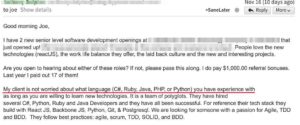
This is the kind of offer I get routinely.

What about this email is different than most of the job postings out there that you routinely see?

Obviously, I put a big fat outline under one of those aspects; that they don’t care if I even know the language. The thing that most starting or junior developers are most worried about–“I need to know XYZ”–a hiring business in my area doesn’t even care about. The big list of qualifications you must have for this job are no where to be seen in this job posting. They’re not asking for 5 years experience in X or 3 years experience in Y.

Why is that?
#

The answer is the difference between a Senior Developer and a Junior Developer. I’ve been thinking a lot about this lately. How to quantify this difference and how to explain this difference to those who have only seen one side of it. How to show someone what they need to know to go from a Junior Developer to a Senior Developer. And if you think it’s just work experience that makes this difference, you’re absolutely wrong. Going from Junior to Senior has much more to do with how you approach the job than with what you do on it.

But what are some things you notice in the email above versus the job postings you get as a new or Junior Developer? What do you think those differences mean?

Related

Don't make these three mistakes in your technical interview

I’ve been running a few tech interviews for the consulting company that I get work from and I’m realizing, most people aren’t very good at it. But that’s understandable. It’s not like we do it very often and it’s hard to get practice in on the interviewee side (interviewers do this all the time). Here are a couple of mistakes I’ve seen recently:

The New World of Work

·662 words·4 mins
When my Dad got out of the Army in 1971, he got a job with AT&T as a repairman. He worked there his whole career for 41 years until he retired two years ago. This was normal for his generation and the generation before his. You got a job at a big corporation right out of college (or the Army) and they took care of you, treated you like one of the family and carried you through your career to a safe, and funded, retirement.

The advantages of hiring remotely

With the latest news that Reddit, of all places, is now forcing all of its employees to move to San Francisco to work in their local office, or go find a new job, I again thank my lucky stars that I have the option to work remotely. It’s a great time we live in when all of the tools we need and all the collaboration we want can happen anywhere in the world at any time.

What makes a great programmer?

·967 words·5 mins
I was browsing Quora recently and came across a question called What are the best kept secrets of great programmers?. These kinds of questions always make me cringe a little. Everyone’s always looking for secrets and shortcuts and the simple fact is, there aren’t any. There’s never just one thing that people-who-get-stuff-done know that no one else can’t figure out.